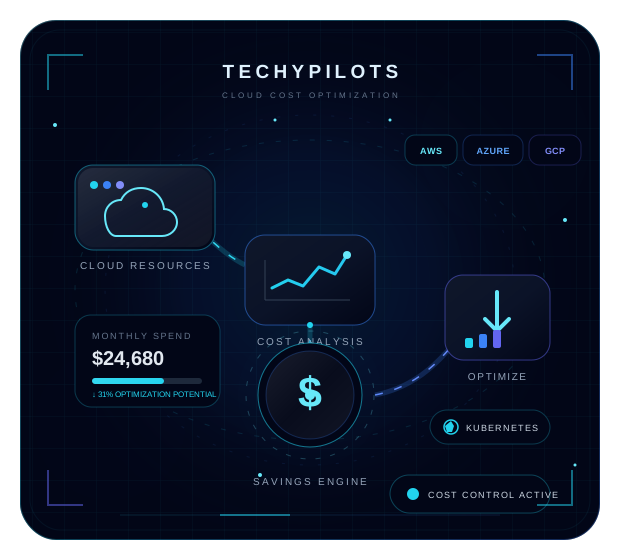
Identify where your cloud budget is being spent and uncover hidden waste.
Rightsize
Match compute, database, storage, and Kubernetes resources to actual workloads.
Reduce
Eliminate unused resources and implement practical cost-saving improvements.
Monitor
Continuously track spending and utilization to prevent cost drift.
Cloud Financial Efficiency
Turn cloud spending into measurable value
Cloud environments can grow quickly as applications, teams, databases, storage, Kubernetes clusters, and infrastructure workloads expand.
We analyze your cloud infrastructure and spending to identify waste, improve resource utilization, optimize architecture, and establish continuous cost governance without compromising application reliability.
Our Cost Optimization Services
Find savings across your entire cloud environment
From compute and storage to databases, Kubernetes, networking, and cloud governance, we identify opportunities to improve efficiency and control spending.
Cloud Cost Assessment
Analyze your cloud environment, spending patterns, resource utilization, architecture, and billing data to identify cost reduction opportunities.
Cloud billing analysis
Resource utilization review
Cost allocation analysis
Savings opportunity assessment
Compute Rightsizing
Identify oversized or underutilized compute resources and recommend more efficient instance types and configurations.
EC2 optimization
VM rightsizing
CPU & memory analysis
Instance optimization
Storage Optimization
Reduce unnecessary storage costs by optimizing volumes, snapshots, object storage, retention policies, and storage tiers.
Object storage optimization
EBS optimization
Snapshot cleanup
Storage lifecycle policies
Database Cost Optimization
Review database infrastructure, utilization, storage, replicas, backups, and capacity to reduce unnecessary database spending.
RDS optimization
Database rightsizing
Replica analysis
Backup optimization
Kubernetes Cost Optimization
Improve Kubernetes resource utilization and reduce cluster spending through workload, node, and resource optimization.
Pod resource optimization
Node optimization
Cluster utilization
Workload rightsizing
Unused Resource Cleanup
Find and remove idle, orphaned, unattached, or unnecessary resources that continue generating cloud charges.
Idle resource detection
Unused volume cleanup
Orphaned resource cleanup
Unused IP identification
FinOps & Cost Governance
Establish practical cloud financial management processes that connect engineering decisions with financial visibility.
FinOps practices
Cost ownership
Budget governance
Cost accountability
Tagging & Cost Allocation
Improve cloud spending visibility by implementing consistent tagging, resource ownership, and cost allocation strategies.
Resource tagging
Cost centers
Team allocation
Environment tracking
Continuous Cost Monitoring
Monitor cloud spending continuously and identify unexpected increases before they become significant operational costs.
Cost monitoring
Budget alerts
Usage monitoring
Anomaly detection
Optimization Areas
Optimize every major cloud cost driver
Cost optimization should cover the complete infrastructure, architecture, and operational environment rather than focusing on a single cloud service.
Compute
Rightsize virtual machines, EC2 instances, node groups, and compute workloads based on actual utilization.
Review database capacity, replicas, storage, backup retention, and workload utilization.
Kubernetes
Optimize pod requests, limits, node groups, autoscaling, cluster utilization, and workload placement.
Networking
Identify unnecessary data transfer, NAT, load balancing, and network architecture costs.
Architecture
Review cloud architecture for unnecessary services, duplicated infrastructure, and inefficient designs.
Cloud Platforms
Optimize the infrastructure you already use
Our optimization approach works across major cloud providers and the infrastructure services that typically contribute to cloud spending.
AWS
Microsoft Azure
Google Cloud
EC2
EBS
S3
RDS
Lambda
EKS
Azure VMs
Azure Storage
Azure SQL
AKS
Google Compute Engine
Cloud Storage
Cloud SQL
GKE
Kubernetes
Cost Optimization Process
A continuous approach to cloud savings
Cloud cost optimization is not a one-time cleanup. We establish a repeatable process for identifying, implementing, and monitoring cost improvements.
01
Discover
Collect billing, utilization, infrastructure, application, and architecture information across your cloud environment.
02
Analyze
Identify idle resources, oversized workloads, inefficient architectures, storage waste, and other savings opportunities.
03
Optimize
Implement rightsizing, cleanup, lifecycle policies, scheduling, architecture improvements, and other cost controls.
04
Monitor
Continuously track spending and utilization to prevent cost increases and maintain long-term cloud efficiency.
FinOps & Governance
Build long-term control over cloud spending
Sustainable cost optimization requires visibility, ownership, governance, and continuous monitoring.
Cost Visibility
Understand where cloud spending is going across accounts, teams, environments, services, and workloads.
Cost Controls
Introduce practical policies and controls that help prevent unnecessary resource creation and uncontrolled spending.
Continuous Monitoring
Track usage and spending trends to identify anomalies and optimization opportunities early.
Financial Accountability
Connect cloud resources with teams, projects, environments, and business ownership.
Business Impact
Spend less without compromising reliability
Effective cloud cost optimization is about making infrastructure more efficient rather than simply reducing resources. We focus on eliminating waste while maintaining appropriate performance, availability, security, and scalability.
Reduce unnecessary infrastructure spending
Improve resource utilization
Identify idle and unused resources
Control storage growth
Optimize database infrastructure
Improve Kubernetes efficiency
Increase cloud cost visibility
Create sustainable FinOps practices
Eliminate Waste
Identify idle instances, unattached volumes, unused IPs, unnecessary snapshots, old resources, and other infrastructure that continues generating costs.
Improve Utilization
Match resources to actual workload requirements and reduce overprovisioning across compute, databases, storage, and Kubernetes.
Prevent Cost Drift
Monitor spending trends, usage, budgets, and anomalies so new infrastructure growth does not silently increase cloud costs.
FAQ
Cloud cost optimization questions
What is cloud cost optimization?
Cloud cost optimization is the process of analyzing cloud spending and infrastructure utilization to eliminate waste, improve resource efficiency, and ensure cloud resources provide appropriate business value.
Can you reduce AWS cloud costs?
Yes. We can analyze AWS services and infrastructure for idle resources, oversized instances, storage waste, database capacity, networking costs, Kubernetes workloads, and other optimization opportunities.
Do you optimize Azure and Google Cloud as well?
Yes. Our approach can be applied across AWS, Microsoft Azure, Google Cloud, and hybrid or multi-cloud environments.
Will cost optimization affect application performance?
Optimization should be based on actual workload utilization and business requirements. Rightsizing and architectural changes should be validated to maintain appropriate performance, availability, and reliability.
How often should cloud costs be reviewed?
Cloud cost optimization should be treated as an ongoing process. Continuous monitoring combined with periodic infrastructure and billing reviews helps prevent cost drift as workloads change.
Share this article
Help others benefit from these insights by sharing this article with your professional network.
Ready to reduce your cloud spending?
Discover where your cloud budget is going, identify optimization opportunities, and build a more efficient and sustainable cloud environment.